Why are GeoTubes Better then Sheet Piling Cofferdam?
Looking to book a service?
Book a free consultation with us.
IMCA-compliant
We respond under 24 hours
Free Inspection
Why Are GeoTubes Better Than Sheet Piling Cofferdams?
When creating temporary or semi-permanent barriers in marine and coastal projects, choosing the right solution is critical. Two commonly used methods are GeoTubes and Sheet Piling Cofferdams. While both serve important purposes, GeoTubes offer several advantages in terms of cost, speed, and environmental impact—especially in shallow and nearshore projects.
What Is a GeoTube?
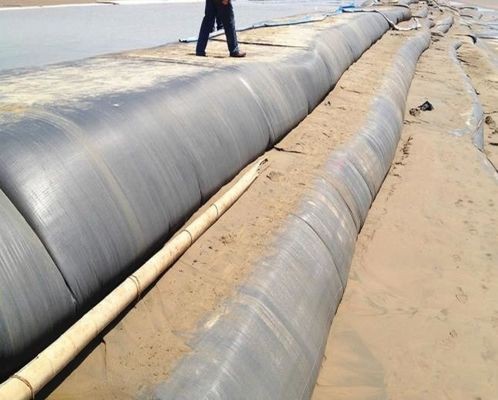
A GeoTube is a high-strength geotextile mesh bag filled with a sand–water slurry. Once filled, the sand settles and water drains out, forming a solid, stable barrier.
GeoTubes are designed to:
Hold back water effectively
Create cofferdams or temporary enclosures
Protect shorelines and marine structures
Be installed without disturbing the seabed
Advantages of GeoTubes Over Sheet Piling Cofferdams
1. No Seabed Penetration Required
GeoTubes rest directly on the seabed and do not require piling or drilling.
This eliminates the need for:
Soil tests
Geotechnical investigations
Seabed clearance reports
This makes GeoTubes ideal for sensitive seabed conditions and environmentally restricted areas.
2. Faster and Easier Installation
GeoTubes can be deployed and filled quickly using locally available sand.
Unlike sheet piling, they do not require heavy piling equipment, vibration, or complex alignment procedures.
This significantly reduces:
Project timelines
Mobilization requirements
Operational downtime
3. Cost-Effective Solution
Compared to sheet piling, GeoTubes are:
Less expensive to manufacture
Cheaper to transport
Faster to install
This makes them an excellent option for small to medium-scale marine projects, emergency works, and temporary cofferdams.
4. Strong Water-Sealing Capability
Once filled, GeoTubes:
Compact naturally as water drains
Form a dense, stable mass
Effectively hold back water without additional reinforcement
Their ability to seal and retain water makes them highly reliable for cofferdam applications.
5. Environmentally Friendly
Because GeoTubes:
Do not disturb the seabed
Create minimal turbidity
Use natural fill material (sand)
They are considered a low-impact and eco-friendly solution, particularly in coastal and nearshore environments.
When Is Sheet Piling the Better Option?
Sheet piling cofferdams are more suitable when:
Working in greater water depths
High structural loads are required
Long-term or permanent structures are needed
Piles must be driven deep into the seabed for stability
However, sheet piling:
Is significantly more expensive
Requires extensive soil testing and approvals
Needs specialized equipment and skilled labor
Takes longer to install
Conclusion
For shallow waters, temporary works, emergency projects, and environmentally sensitive areas, GeoTubes are often the better choice. They provide a strong, fast, and cost-effective barrier without the complexity and high costs associated with sheet piling cofferdams.
Sheet piling remains valuable for large-scale, deep-water, and permanent marine structures, but when simplicity, speed, and cost-efficiency are priorities, GeoTubes offer a superior alternative.
Other Blogs
Browse Related Blogs
FAQ
Frequently Asked Questions
Everything you need to know about HHA Diving’s certified commercial diving & civil work solutions in the GCC.